Quick answer: To stop casino addiction, ban yourself through your state's self-exclusion program, close every online and sweepstakes casino account, and put a gambling blocker on each device. Then stop the casino mail and free-play offers, let someone you trust watch your money, plan for urges, and get support. Free 24/7 help: 1-800-MY-RESET.
Types of gambling
How to Stop Casino Addiction: Self-Exclusion, Blockers and a 10-Step Plan
By QuitBet Addiction Research Team · Updated · 13 min read
On this page
This guide covers how to stop casino addiction whether you play slots on a casino floor, blackjack in an app or "free" coins on a sweepstakes site. Each one hooks you differently, so each needs its own exit.
Why is casino gambling so hard to quit?
Casino gambling is hard to quit because the rewards and marketing are designed to bring you back, and the casino can now follow you onto your phone. The buildings haven't faded, either: US commercial casinos kept a record $50.94 billion from gamblers in 2025, $37.12 billion of it from slot machines, according to the American Gaming Association (AGA).
In-person casinos: players' cards, comps and hosts
Your players' card is how the casino gets to know you. You slide it into a slot machine or hand it to the dealer so your play is "tracked and rated," and that record decides what you're offered: free play, meals, a hotel room. Comps are usually based on your "theoretical loss," which is what the casino expects to win from you. Hosts are there to build a relationship with you, and the offers follow you home by mail, email, text and phone (Responsible Gambling Council).
Keep that in mind the next time a free-play mailer shows up with your name on it.
Nobody has proven that loyalty programs cause gambling problems, but the overlap is hard to ignore. In Australian surveys, 46.5% of people with a gambling problem used a loyalty card, compared with 10.5% of people who gambled without problems (Delfabbro & King, 2020).
Legal online casinos: open all night, in your pocket
As of October 11, 2026, real-money online casinos are live in seven states: Connecticut, Delaware, Michigan, New Jersey, Pennsylvania, Rhode Island and West Virginia (AGA). Maine has legalized internet gaming, but its Gambling Control Unit says it is not yet accepting license applications. Its latest rulemaking notice, published September 30, takes comments until October 30, 2026. Those pages do not confirm a launch date.
An online casino never closes and never sees your face. US online casinos kept $10.74 billion from players in 2025, up 27.6% in one year, and in New Jersey, Pennsylvania and Michigan they now out-earn the brick-and-mortar casinos (AGA).
Offshore sites are the unofficial fourth kind. They're unlicensed, easy to find and outside state self-exclusion. When Michigan sent cease-and-desist letters to 33 of them on October 8, 2026, its gaming board director said of self-exclusion, "Offshore sites don't respect it" (CDC Gaming).
Sweepstakes and social casinos: "free" coins, real cash prizes
Sweepstakes casinos such as Chumba Casino and Stake.us run slots and table games on two currencies. At Chumba, you buy Gold Coins and play with Sweeps Coins, which you can redeem (Chumba's policy). New York's ban describes the model plainly: a dual-currency system that lets players exchange currency for cash prizes (NY Senate). Because you never "deposit" or "bet," it's easy to tell yourself it doesn't count. If you're quitting gambling, count it.
States are cracking down. At least 10 have banned these games since mid-2025: Connecticut, Montana and New Jersey (CasinoBeats), California (signed October 11, 2025), New York (signed December 5, 2025), and in 2026 Indiana, Tennessee, Louisiana, Maine and Oklahoma. Oklahoma's ban starts November 1, 2026.
The three kinds of casino gambling compared
| Type | Where it's available | Why it's hard to quit | How to block or exclude yourself |
|---|---|---|---|
| In-person casinos | Commercial and tribal casinos in many states | Players' cards, comps, free-play mailers and hosts | State self-exclusion; separate requests at tribal casinos; close your players' card |
| Legal online casinos | CT, DE, MI, NJ, PA, RI, WV (Maine legal, not yet live) | Always open, on the phone in your hand | State online self-exclusion, account closure, a blocker on every device |
| Sweepstakes and social casinos | Marketed widely; banned in at least 10 states since 2025 | Feels free, but Sweeps Coins pay cash prizes | Self-exclude or close each site; a blocker that covers social casinos |
| Offshore online casinos | Unlicensed, but reachable from any state | They ignore self-exclusion lists | Blockers and money friction only |
What are the signs of casino addiction?
Casino addiction is gambling disorder where casino games are the main draw. Clinicians use the DSM-5's nine criteria: four or more within 12 months, with real distress or impairment, meets the bar. For casino players, that can look like this:
- You need bigger bets, higher-limit machines or longer sessions for the same rush.
- You get restless or irritable when you try to stay away.
- You've called a trip "the last one" before.
- You plan the next visit when you're supposed to be doing something else.
- You head to the casino after a bad day, or because the weekend feels empty.
- After a losing night, you go back soon to win it back.
- You hide trips, ATM withdrawals or app purchases.
- Gambling has strained a relationship or put your job at risk.
- You've needed someone else's money to cover your losses.
Only a clinician can diagnose gambling disorder, but if several of these sound familiar, take Gamblers Anonymous's free 20 Questions.
How do I ban myself from a casino?
Sign up for your state's self-exclusion program. One enrollment bars you from every licensed casino in that state. There's no national list, so repeat it in each state where you play. Four examples:
- In Massachusetts, you choose 1, 3 or 5 years away from all casino floors and sports betting. You can extend a term but never shorten it, and you forfeit your rewards points (Massachusetts Gaming Commission).
- In Michigan, you can't apply to come off the Detroit casino list until you've been on it for 5 years, and showing up at a Detroit casino in the meantime can mean a criminal trespassing charge (Michigan Gaming Control Board).
- Pennsylvania keeps separate lists for casinos, online gambling, video gaming terminals and fantasy contests, so a casino ban doesn't cover online play (Pennsylvania Gaming Control Board).
- New Jersey's in-person or video route covers Atlantic City casinos and online gambling for 1 year, 5 years or life (NJ Division of Gaming Enforcement).
To find your program, search your state's gaming commission plus "self-exclusion," or ask 1-800-MY-RESET.
What about tribal casinos?
Tribal casinos may not be on your state's list. California's statewide list covers licensed cardrooms, and the state attorney general says it doesn't include tribal casinos. Ask the players' club or security office at each tribal casino how to exclude yourself there.
How do I self-exclude from online casinos?
Use your state regulator's online list. Michigan's covers online casino games, online sports betting or both for 1 or 5 years, and it ends automatically when the term is up (Michigan Gaming Control Board). Pennsylvania and New Jersey have online options too.
State lists bind only licensed gambling operators, so with sweepstakes casinos you go site by site. Chumba Casino offers self-exclusion for 6 months, 1, 3 or 5 years, or indefinitely, and it unsubscribes you from marketing. It covers only that one site, not sister sites run by the same company, unless you ask support. A permanent closure, also through support, can't be undone (Chumba's policy, July 2025).
How do I stop the mailers and free play?
Self-exclusion usually ends the rewards too: Massachusetts makes you forfeit your points, and Pennsylvania bars excluded people from accepting comps. If you're not there yet, call the players' club, close your card and ask to come off every mailing list. Throw out anything that still arrives, unopened.
How to stop casino addiction: 10 steps
A single barrier is easy to get around at midnight, so stack several. Do the first four this week.
1. Self-exclude everywhere you play
Join your state's casino list, its online list if that's separate, and the list in any neighboring state you drive to. Then ask each tribal casino you visit about its own program.
2. Close every online and sweepstakes casino account
Deleting the app isn't enough, because the account is still there. Withdraw or redeem your balance, choose permanent closure or the longest exclusion offered, and ask support to cover sister sites. Then try logging in to make sure it worked.
3. Block casino sites and apps on every device
Once the accounts are closed, the browser becomes the back door, so put a blocker on every phone and computer you use.
- QuitBet combines native Screen Time blocking on iPhone with a panic button, an AI coach, Learn and Community.
- Gamban provides dedicated gambling blocking across phones and computers. Its help center lists social casinos among the things it blocks.
- BetBlocker offers scheduled gambling restrictions on Windows, Mac, Linux, Android and iOS.
- Apple Screen Time is free and can block specific websites and apps behind a passcode, but you add each site yourself. Let someone you trust set the passcode.
Then try the casino and sweepstakes sites you used, and add any that still load. Our Gamban vs BetBlocker vs QuitBet comparison goes deeper.
Use the gambling blocker finder to get setup steps for your device and country, including bank controls and self-exclusion guidance.
4. Put distance between you and your money
Delete saved cards from your browsers and casino apps, and leave the debit card at home on days you'll pass a casino. Let someone you trust hold a credit card or see your account alerts.
Ask your bank what it can lock or block. Gambling blocks are common at UK banks but hard to find in the US. A credit freeze is free and lasts until you lift it, so opening a new card to gamble with gets much harder.
5. Cut off the casino triggers
Drive a different way home if your usual route passes the casino, and skip casino bus trips and casino-hotel concerts for now. Unsubscribe from casino emails, text STOP to promo messages, and turn off casino app notifications. If payday or a quiet Saturday is when it hits, book something for exactly that time.
6. Have a plan for urges
A craving is strongest for a short stretch and then eases off if you don't feed it, so buy time. Promise yourself you won't decide for 15 minutes, and spend them moving. Picture the whole trip, including the ATM and the drive home.
Have a short breathing or focus exercise ready for that window. Put the exercise and your support person's number beside your written urge plan.
The free urge surfing timer gives you a guided ten-minute pause while you choose what to do next. Keep your longer pause in place if the urge is still strong afterward.
7. Tell one person
Secrecy keeps a gambling problem going, so tell one person: a partner, a sibling, a friend or someone in recovery. You could say, "I've been gambling more than I've let on, and I'm stopping. Can I call you when I want to go?"
8. Get support (much of it is free)
The National Problem Gambling Helpline, 1-800-MY-RESET (1-800-697-3738), answers calls, texts and chats 24/7 and works in all 50 states. Gamblers Anonymous is free, with meetings in person, online and by phone.
Therapy helps too. A 2023 review of 29 clinical trials found psychological treatment reduced gambling severity, and cognitive behavioral therapy (CBT) had the strongest evidence. Telehealth providers such as Birches Health treat gambling by video, and some states pay for care: North Carolina offers up to 12 free sessions. See gambling rehab vs Gamblers Anonymous vs therapy to compare.
9. Handle the money damage without chasing
Playing to win it back digs the hole deepest, because the house edge applies to that money too. Add up every debt, including what you owe family. Pay for housing, food and getting to work first, and call lenders about hardship plans before you miss a payment.
If you used online casino accounts, the gambling loss calculator can help you total net losses from statements. Include deposits, withdrawals and cash balances across every account for the same period.
If the losses have you thinking about suicide, call or text 988 now. You're far from alone: a 2024 review of 107 studies found that about a third of people with gambling problems had thought about suicide (Kristensen et al.). Debt can be paid down over time. Get through tonight first.
10. Plan for a slip
If you gamble again, leave or log out right away, and skip the "one more" to get even. Tell your person or call 1-800-MY-RESET that day. Then find the gap you slipped through, like a new account or an unblocked laptop, and close it. One bad night doesn't cancel the weeks before it.
Are blackjack and roulette addiction different?
Not much. The disorder is the same, but blackjack and roulette add a feeling of skill or pattern-reading that the math doesn't back up.
Roulette is pure chance. An American wheel has 38 pockets, including 0 and 00, so a $100 bet on red loses $5.26 on average (DePaul University). The wheel has no memory. Ten reds in a row don't make black "due."
Blackjack involves more skill than the other three games in the UNLV Center for Gaming Research report. Its 2025 Nevada figures show a 12.8% table hold for blackjack and 18.8% for roulette. Table hold is casino win divided by drop, the money recorded entering play, not the sum of every wager (Nevada Gaming Control Board, standard 168). It is a different measure from the 5.26% mathematical edge on an American roulette red bet, so those numbers are not directly comparable. If you keep thinking you just need a better system, notice that thought. It's the one that walks you back to the table.
Slots work differently. See our guide to slot machine addiction.
What can a recovery app help you do?
A recovery app can help you keep a daily record and a response to casino urges close at hand. Write down the situation that set off an urge, what you did instead of gambling and what you want to change for tomorrow.
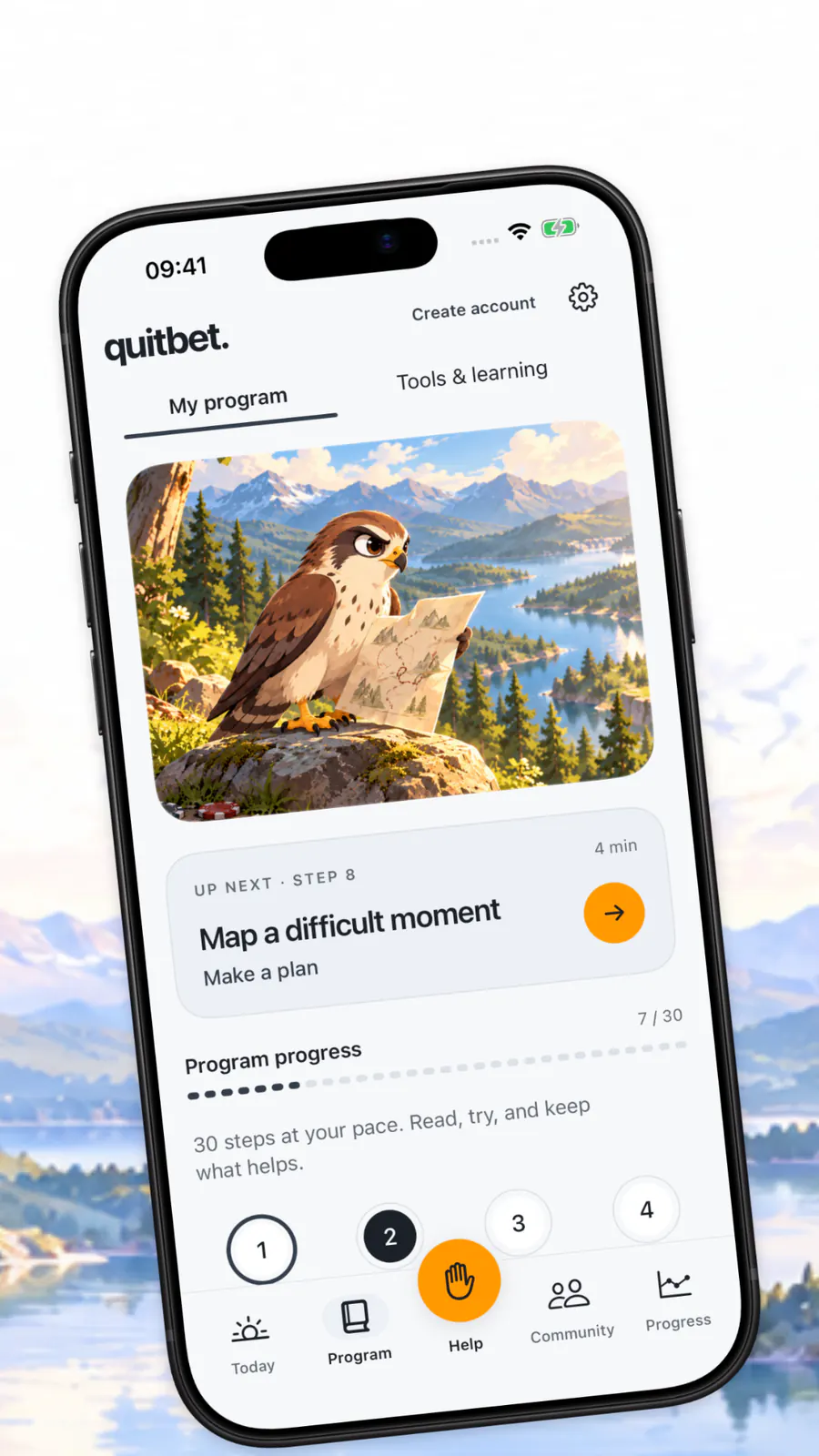
QuitBet, for iPhone with iOS 18 or later, combines cravings and mood check-ins with Screen Time blocking, a personalized quit plan, a panic button and an AI coach. Learn and Community add recovery information and peer support. Compare platforms, blocking and support features in our guide to the best apps to quit gambling.
Free worksheets and a first-day plan
Use the free recovery checklist to track account closures and self-exclusion requests, and the urge-plan worksheet for the next risky moment. Our first-day plan for quitting gambling covers where to begin.
FAQ
How do I ban myself from a casino?
Enroll in your state's self-exclusion program through its gaming commission. One sign-up covers every licensed casino in that state, but there's no national list. Tribal casinos may run their own programs, so ask each one directly.
Can I self-exclude from online casinos?
Yes, in states with legal online casinos. Michigan, Pennsylvania and New Jersey all run online self-exclusion lists. Offshore and sweepstakes sites aren't covered, so close those accounts one by one and use a blocker.
Are sweepstakes casinos gambling?
For recovery, yes. You spend real money on casino-style games played with a currency that can be redeemed for cash prizes. At least 10 states, including California and New York, have banned them since 2025.
Is casino addiction the same as gambling addiction?
Yes. Casino addiction is gambling disorder centered on casino games, and clinicians use the same nine DSM-5 criteria whatever the game. If you also bet on sports, see how to stop sports betting.
Can a casino refuse to let me in if I'm self-excluded?
Yes. In Massachusetts, an excluded person found on the gaming floor is escorted out and forfeits any money wagered or won, and casinos can extend the ban to their non-gaming areas. In Michigan, going back to a Detroit casino can lead to a criminal trespassing charge.
How do I stop thinking about the casino?
Cut the cues first: mailers, emails, app notifications and the drive past the building. When the thought comes, put off any decision for 15 minutes and do something physical. If it's still constant after a few weeks, talk to a counselor or call 1-800-MY-RESET.
What do I do if I relapse?
Stop, tell someone that day, and work out how it happened so you can close that gap. One relapse doesn't undo your progress. If it keeps happening, add a layer, like regular GA meetings.
Need to talk to someone right now? Call or text 1-800-MY-RESET (1-800-697-3738), or chat online, to reach the National Problem Gambling Helpline. It's free and confidential, and it's open 24/7. If you're having thoughts of suicide, call or text 988.
The QuitBet app
Keep your daily plan close
QuitBet for iPhone and Android brings your quit plan, check-ins, gambling blocking and urge tools together.
- Quick help for the moment an urge hits
- Daily check-ins, streaks and money saved
- A blocker for gambling apps and websites
- A community of people quitting too
On a computer?Scan with your phone camera to get QuitBet on iPhone or Android.
Rated 4.4 on the App StoreFree to start on iPhone and Android.