Quick answer: To stop sports betting, close every sportsbook and DFS account (don't just delete the apps), join your state's self-exclusion program, and install a gambling blocker on every device. Then remove saved cards, mute betting content, plan for game days, and tell one person. Free help is available 24/7 at 1-800-MY-RESET.
Types of gambling
How to Stop Sports Betting: A Practical 11-Step Plan
By QuitBet Addiction Research Team · Updated · 13 min read
On this page
If you've searched "how to stop sports betting" more than once, usually after a bad night, this guide is for you. It covers the warning signs, how to quit sports betting in 11 steps, which blocking tools to use, and where to find free help tonight.
Why is it so hard to stop betting on sports?
Sports betting is hard to quit because the sportsbook never closes and it lives on the phone that's always in your hand. Missouri became the 39th state with legal sports betting in December 2025, and Washington, DC allows it too. Americans legally bet $166.94 billion on sports in 2025, and 96.5% of sportsbook revenue came from online betting, according to the American Gaming Association (AGA).
It also feels like skill. You know the teams, so a loss feels like a bad read you can fix by studying harder. Meanwhile, sportsbooks kept about 10 cents of every dollar bet in 2025 (a 10.16% hold, per the AGA).
Parlays make it worse. 30% of sports bettors made parlay bets in 2024, up from 17% in 2018, according to the National Council on Problem Gambling (NCPG). When one leg out of six misses, it feels like you almost won. Live betting tightens the loop: lose on one drive, bet the next one before the snap.
And it's everywhere, from the spreads on the pregame show to the slips in your group chat. After a bad beat, betting bigger to win it back feels like fixing a mistake. That's chasing, one of the nine criteria for gambling disorder.
What are the signs of a sports betting addiction?
The clearest sign is that you keep betting after it starts costing you things you care about, and you can't stop when you try. Clinicians diagnose gambling disorder with the DSM-5, which lists nine criteria. Four or more within 12 months, with real distress or impairment, meets the bar.
For sports bettors, that often looks like this:
- You bet bigger, add legs or move to live betting to get the same rush.
- You get restless or irritable on days you try not to bet.
- You've tried to cut back or quit and couldn't.
- You think about lines and picks at work, at dinner, in bed.
- You bet more when you're stressed, bored or down.
- After a bad loss, you bet again soon to win it back.
- You hide how much you bet.
- Betting has hurt a relationship, your job or school.
- You've needed someone else's money to cover a hole betting caused.
Only a clinician can diagnose gambling disorder, but if a few of these hit home, try Gamblers Anonymous's free 20 Questions. You don't have to fit the "degenerate gambler" stereotype from the group chat for this to count. A problem can be real long before you're broke.
How to stop sports betting: 11 steps
Cut off access first (steps 1 to 4), then build the habits and support that keep you stopped (steps 5 to 11). Most advice on how to quit sports gambling stops at "delete the app," which is really step zero. Any one of these steps can fail on a bad night, but stacked together they buy you time to choose. Do the first four this week, today if you can.
1. Close your sportsbook and DFS accounts (don't just delete the app)
Deleting the app isn't enough. Reinstalling takes a minute, and your account, saved card and promo emails are still there. Close the account instead:
- Withdraw any balance to your bank.
- In each app, open Responsible Gaming and choose self-exclusion or permanent closure. Pick the longest period offered, and if you can't find the option, ask support.
- Try logging in afterward. If it works, contact support again.
Tennessee's regulator lists the in-app self-exclusion steps for DraftKings' fantasy app, PrizePicks and Underdog. Do every account, including offshore sites and DFS or pick'em apps. If you quit the sportsbook but still build a six-pick entry every night, you haven't quit. Close online casino accounts too (see how to stop casino addiction and slot machine addiction).
2. Sign up for your state's self-exclusion program
Many states with legal sports betting run a self-exclusion list that bars you from every licensed operator in the state with one sign-up.
- In Massachusetts, the "Sports Only" option covers all sportsbooks and online sports wagering platforms in the state for 1, 3 or 5 years. You can extend a term but never shorten it, and coming off the list takes a reinstatement session (Massachusetts Gaming Commission).
- In New Jersey, minimum terms are 1 year, 5 years or lifetime. Lifetime requires enrolling in person or by video; online sign-up offers 1 or 5 years (NJ Division of Gaming Enforcement).
There's no single national list. Each program covers operators licensed in that state, so sign up wherever you bet, including the state next door you drive to on Sundays. State lists also miss offshore sites and prediction market apps. That's the gap a blocker fills. To find your program, search your state's gaming commission plus "self-exclusion," or ask 1-800-MY-RESET.
3. Install a gambling blocker on every device
A gambling blocker stops betting sites and apps from loading. Put one on your phone, tablet and laptop, because once the app is gone, the browser becomes the backup sportsbook.
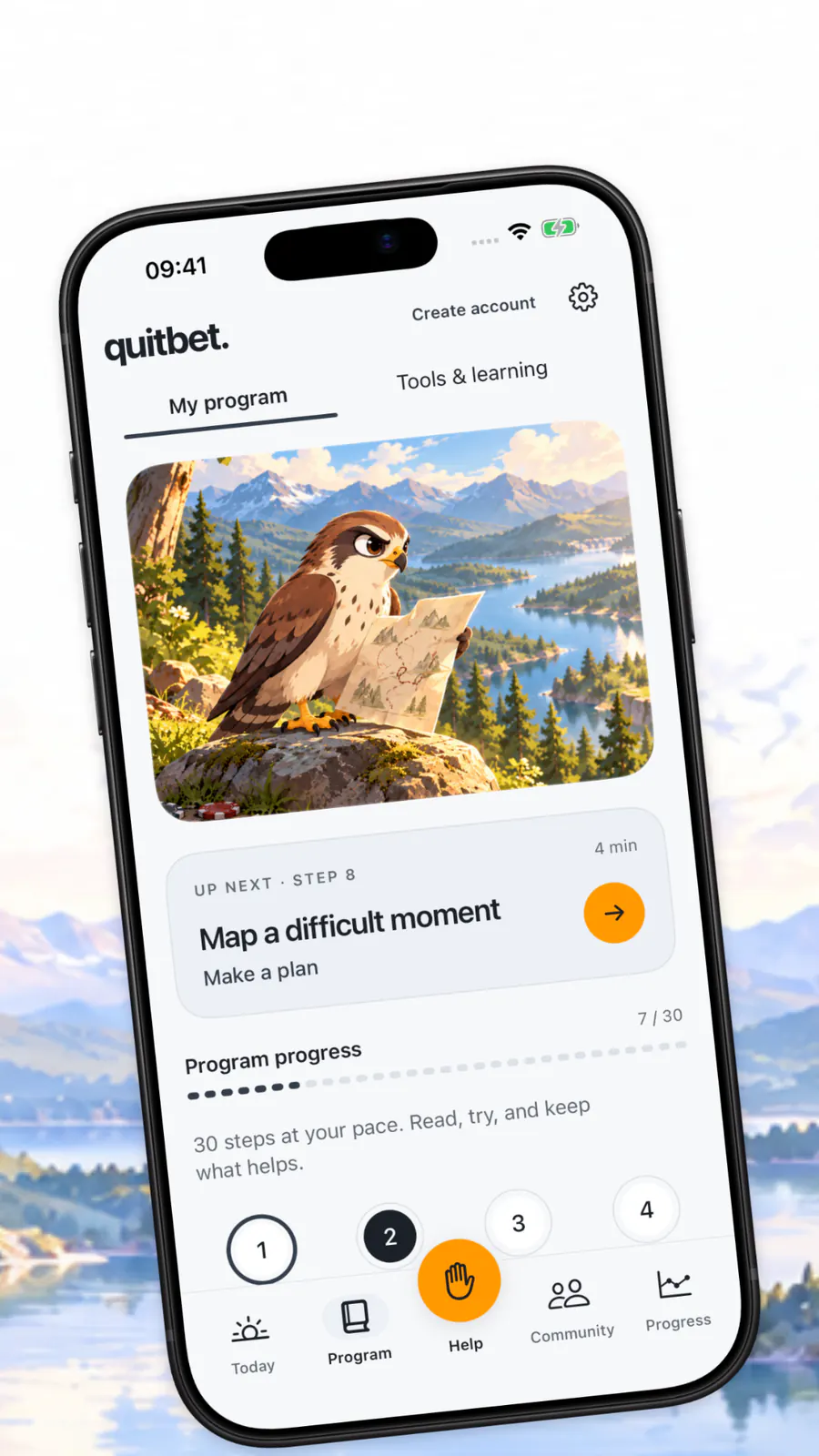
- QuitBet combines native Screen Time blocking on iPhone with an AI coach, panic button, Community and a daily quit plan.
- Gamban is a dedicated blocker for gambling apps and sites across phones and computers.
- BetBlocker offers scheduled gambling restrictions on Windows, Mac, Linux, Android and iOS.
- Apple Screen Time is free and can block specific websites and app downloads behind a passcode. There's no gambling category, so you add sites one at a time. Let someone you trust set the passcode.
We compare these in Gamban vs BetBlocker vs QuitBet and cover recovery apps in our best apps to quit gambling roundup.
For steps matched to your device and country, use the gambling blocker finder. Check each device separately, then add the bank controls and self-exclusion options available where you live.
4. Put friction between you and your money
Every deposit route you remove adds a step between the urge and the bet.
- Delete saved cards from your browser and unlink PayPal or any payment app you've deposited with.
- Let someone you trust hold your credit card for a while or get alerts on your accounts.
- Call your bank. Gambling blocks are common at UK banks but hard to find in the US, so ask what yours can do, like locking a card or blocking specific merchants.
- Freeze your credit. A credit freeze is free, lasts until you lift it, and stops lenders from pulling your report, so opening a new card or loan to bet with gets much harder.
5. Cut off the betting triggers
Clear out the marketing and the noise the same day you close your accounts. Unsubscribe from sportsbook emails, reply STOP to promo texts, and turn off push alerts from sports apps that show odds. Mute the betting podcasts, tipsters and "lock of the day" accounts. Leave or mute the group chat that posts slips; "I'm taking a break from betting" is all the explanation you owe.
Your own triggers count too: payday, a bad day at work, a quiet Sunday alone, a few beers during the game.
6. Make a game-day plan
Knowing how to stop betting on sports on a quiet Tuesday is one thing. Big game days are harder, because everything around you is about the bet. Plan for NFL Sundays, March Madness, the Super Bowl and your own team's games before they arrive.
- Decide ahead what you'll watch and with whom. People who don't bet are the best company.
- Watch on a TV and leave your phone in another room. That's where live betting happens.
- Skip the pregame betting shows and tune in at kickoff.
- For March Madness, do a free bracket with no money on it, or sit out the pool this year.
- At a Super Bowl party, know when you'll leave and who you'll text if it gets to be too much.
7. Learn to ride out an urge
An urge to bet feels like it'll keep building until you act on it. It won't. Urges come in waves: they build, peak and fade even if you do nothing. Your job is to get past the peak.
Tell yourself you'll decide in 15 minutes, then spend those minutes doing something else. Change rooms or go outside. Play the tape forward: if the bet loses, you're down more, and if it wins, be honest about what you'd do with the money. Text your person. Later, write down what set the urge off.
A short breathing or focus exercise can give you something to do during that pause. Choose the exercise before game day and keep it within reach.
Try the free urge surfing timer for a guided ten-minute pause: notice what you feel, choose a different activity and reach out to your support person. You can continue the pause if you still want to bet when the timer ends.
8. Tell one person
Gambling problems grow in secret, so you need one person who knows. Not everyone. One. A partner, a sibling, a close friend or someone in recovery. You could say:
"I've been betting more than I've let on, and I'm trying to stop. I don't need you to fix it. Can I text you when I want to place a bet?"
If there's no one yet, start with the helpline in step 9. It's confidential, and the people who answer hear stories like yours every day.
9. Get support (much of it is free)
- The National Problem Gambling Helpline, 1-800-MY-RESET (1-800-697-3738), answers calls, texts and chats 24/7 and can connect you with help in your state.
- Gamblers Anonymous charges no dues or fees and holds meetings in person, online and by phone.
- Therapy helps. A 2023 review of 29 clinical trials found psychological treatment reduced gambling severity, and cognitive behavioral therapy (CBT) had the strongest evidence. Long-term effects are less clear.
- Birches Health, a telehealth program for gambling and sports betting, says it's in-network with most major insurers and lists a $21 average copay per session.
- Some states pay for treatment. North Carolina offers up to 12 sessions of confidential, no-cost treatment. The helpline can tell you what your state offers.
For a side-by-side look, see gambling rehab vs Gamblers Anonymous vs therapy.
10. Handle the money damage without chasing
Trying to win it back is the most expensive idea you'll have. Sportsbooks keep about 10 cents of every dollar bet, so betting more to get even usually digs the hole deeper.
- List every debt, including money borrowed from friends or family, and get the real total.
- Cover housing, utilities, food and getting to work first.
- Call lenders before you miss a payment and ask about hardship options.
- Don't borrow to cover losses. The credit freeze from step 4 helps.
If the losses have you thinking about ending your life, call or text 988 right now. Money problems can be worked out, and you don't have to work them out alone.
11. Plan for a slip
A slip doesn't erase your progress. It shows you where the gap is. Decide now what you'll do in the first 24 hours after a bet:
- Stop the session. Log out, and skip the "last one" to win it back.
- Tell your person or call 1-800-MY-RESET that day.
- Work out how it happened (a new account, an unblocked device, a friend's phone) and close that gap.
- Get back to your plan the next day, with a GA meeting or a counseling session if you can.
Thirty days with one slip is still a very different month from thirty days of betting.
Which tools block sports betting?
Account closure and state self-exclusion restrict gambling accounts. Device blockers add a barrier to betting sites and apps, while recovery tools help you plan what to do during an urge. Match each tool to the part of your plan it covers.
| Option | What it does | How it fits your plan |
|---|---|---|
| Closing your sportsbook or DFS account | Closes access at that operator | Close every account you used |
| State self-exclusion (e.g., MA, NJ) | Restricts licensed sportsbooks covered by that state's program | Add state-wide account barriers; check local coverage |
| QuitBet | Blocks gambling apps and sites on iPhone; includes coaching, urge tools, learning and community | iPhone blocking with daily planning and urge tools. Free to start |
| Gamban | Blocks gambling sites and apps across phones and computers | Cover a laptop or other device where you also bet |
| BetBlocker | Sets gambling restrictions on Windows, Mac, Linux, Android and iOS | Add scheduled restrictions across devices |
| Apple Screen Time | Restricts selected sites and app downloads | Ask a trusted person to hold the passcode for your manual settings |
Can you still watch sports after you quit betting?
Yes, you can still watch sports after you quit betting, but you'll probably need to change how you watch. Stick to games you'd care about with no money on them, like your team or the playoffs, and drop the ones you only watched to sweat a bet. Watch with friends who don't bet, or who at least know you've stopped.
If you catch yourself checking lines "just to see," treat it as an urge. And if every game turns into one, take a few weeks off. The sport will still be there.
Where can an app fit into a sports-betting plan?
A recovery app can hold your game-day plan, urge exercises and daily check-ins. Before kickoff, decide what you will do if you start checking odds and confirm that betting access is blocked on each device.
QuitBet brings these tools together on iPhone with iOS 18 or later: a personalized quit plan, Screen Time blocking, a panic button and an AI coach. After a game, its check-ins let you record cravings and mood; Learn and Community offer education and peer support. Use your notes to spot which games or situations need a different plan next time.
Free worksheets and a first-day plan
Write down your next risky fixture in the free game-day plan and use the recovery calendar for check-ins. For a shorter starting point, use our first-day plan for quitting gambling.
FAQ
Is sports betting addiction real?
Yes. Gambling disorder is a diagnosis in the DSM-5, and the same nine criteria apply whether you bet on sports or play slots. Sports betting addiction is gambling disorder where sports betting is the main activity.
Can I self-exclude from every sportsbook at once?
Not nationally. There's no single US self-exclusion list; each state runs its own program for operators licensed there. One sign-up covers every legal sportsbook in your state, but you still need to close other accounts and use a blocker for offshore sites.
Is deleting the sportsbook app enough?
No. Your account, balance and saved card are still there, and reinstalling takes a minute. Close or self-exclude each account, then install a blocker so the website doesn't become your new sportsbook.
How do I stop betting on parlays?
Treat parlays like any other bet: close the accounts instead of trying to stick to "small parlays only." A $5 ticket with a huge payout is easy to justify again and again, and near-misses make losses feel like almost-wins.
What if I already lost a lot of money?
Stop betting first, including bets meant to win it back. List every debt, cover essentials, and call lenders about hardship options before you miss payments. If the losses have you thinking about suicide, call or text 988.
How long do sports betting urges last?
There's no fixed clock, and it varies by person. A single urge tends to build, peak and fade if you don't act on it, which is why delaying and distracting yourself help. Big games and paydays can bring urges back, so keep your game-day plan.
Do PrizePicks and Underdog count as sports betting?
For recovery, yes. Whatever the legal label, you're putting money on sports outcomes, and the pull works the same way. Both apps let you self-exclude from their Responsible Gaming menus.
Where can I get free help to stop gambling on sports?
Call, text or chat 1-800-MY-RESET (1-800-697-3738), the free, 24/7 National Problem Gambling Helpline. Gamblers Anonymous meetings are also free, and some states fund free treatment, such as North Carolina's up to 12 no-cost sessions.
Need to talk to someone right now? Call or text 1-800-MY-RESET (1-800-697-3738), or chat online, to reach the National Problem Gambling Helpline. It's free and confidential, and it's open 24/7. If you're having thoughts of suicide, call or text 988.
The QuitBet app
Keep your daily plan close
QuitBet for iPhone and Android brings your quit plan, check-ins, gambling blocking and urge tools together.
- Quick help for the moment an urge hits
- Daily check-ins, streaks and money saved
- A blocker for gambling apps and websites
- A community of people quitting too

On a computer?Scan with your phone camera to get QuitBet on iPhone or Android.
Rated 4.4 on the App StoreFree to start on iPhone and Android.